
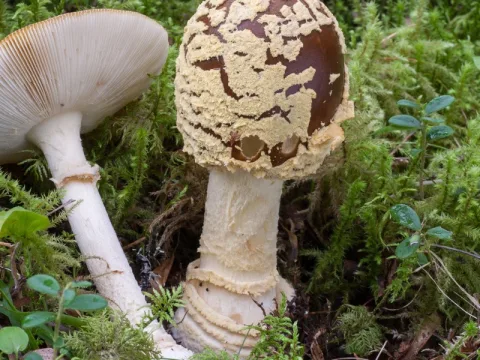
Blusher
Amanita rubescens

Fungi can be grouped in different ways. In biology, taxonomic groups such as families and genera are used to describe evolutionary relationships, whereas for mushroom foragers it is often more practical to focus on appearance and other visible characters. On Svampguiden, species are therefore arranged in practical morphological groups, where fungi with a similar overall appearance are placed together, even though these groups do not always reflect their closest taxonomic relationships.
Agarics with free gills and white spore print. Cap surface often with veil remnants. Stem with or without ring. Stem base with volva or velar scales. Mycorrhizal with coniferous and deciduous trees. About 30 species in the Nordic region.
Amanita rubescens
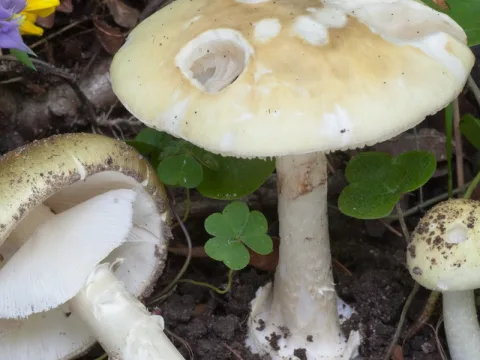
Amanita phalloides

Amanita virosa
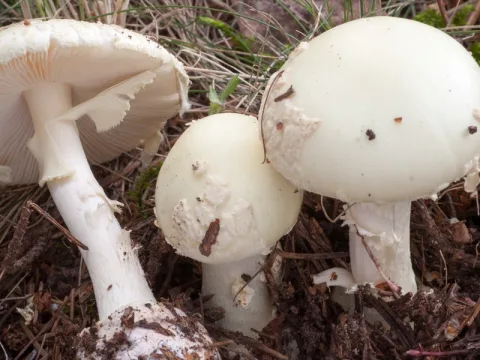
Amanita citrina
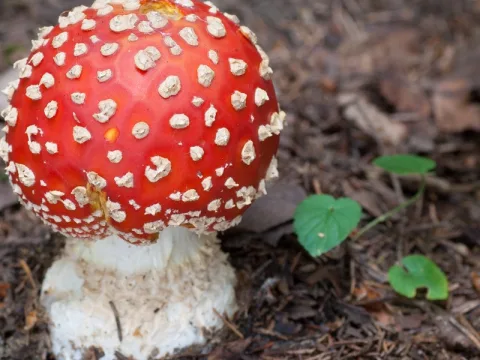
Amanita muscaria s.lat.

Amanita excelsa
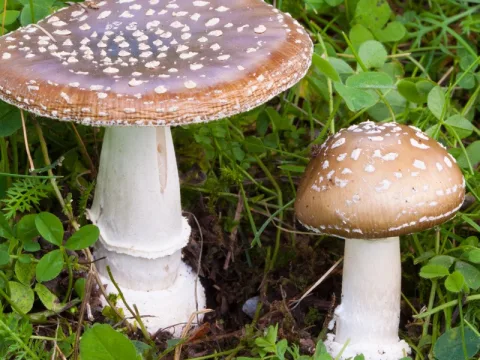
Amanita pantherina
Amanita regalis

Amanita ceciliae