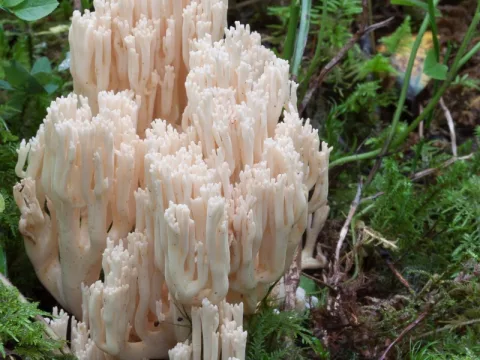
- Fruitbody branched, coral-like, 10-15 cm tall.
- Base stout, whitish, upwards passing into a bush-like branching structure.
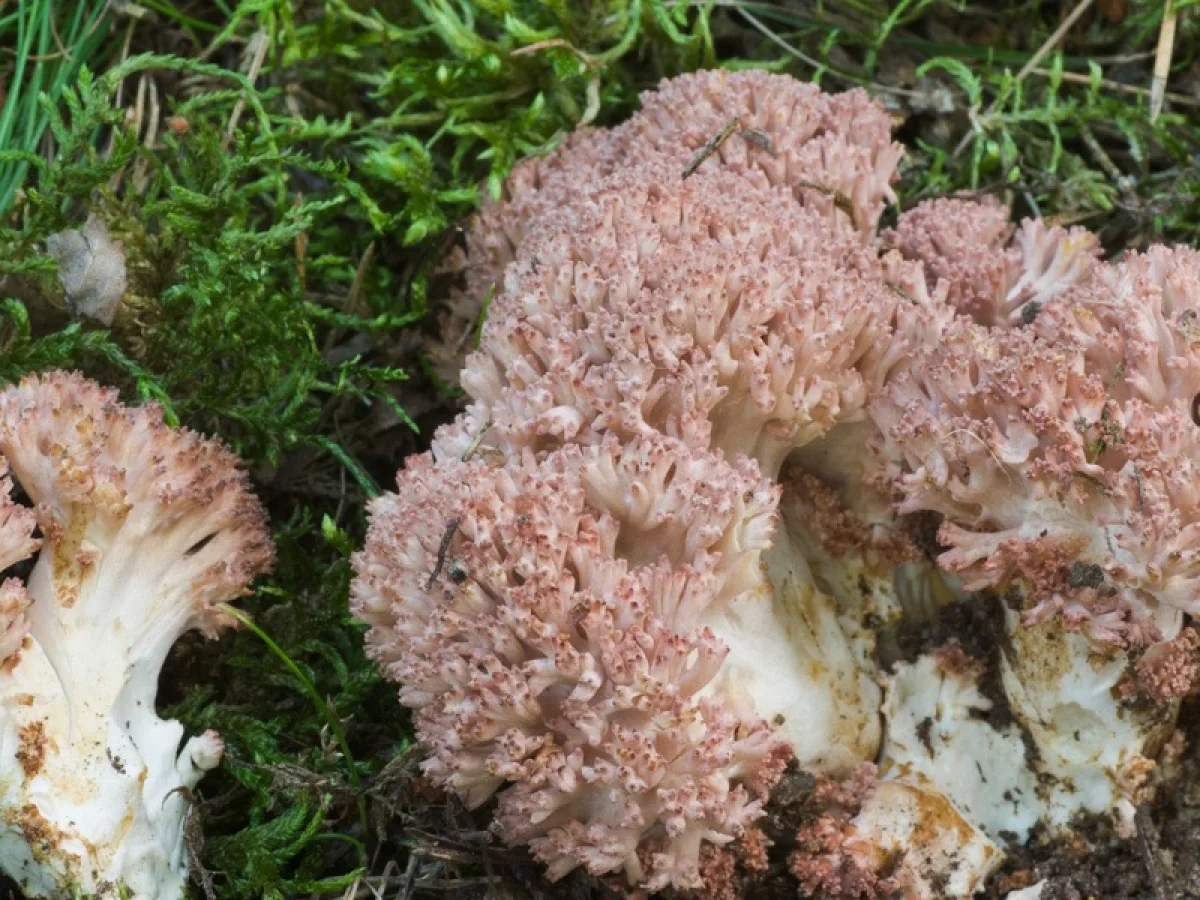
- Branches whitish, with pink to reddish-violet, blunt tips.
- Flesh compact, white.
- Taste mild, sometimes somewhat bitter in the branch tips.
Coral fungi
Rosso Coral agg.
Ramaria botrytis s.lat.
NA
Not applicable
Edible
7 images
Characteristics
Ecology
Occurs mainly in oak and beech forest in the southern parts of the Nordic region, but also grows in mossy coniferous and mixed forest farther north.
Notes
Very good edible mushroom. Like Sparassis crispa, it is excellent deep-fried. With age the taste becomes bitter, so only young specimens with reddish-violet tips should be collected.
Rosso Coral agg. is used here as a collective name for several closely related and difficult-to-separate species.
Rosso Coral agg. is used here as a collective name for several closely related and difficult-to-separate species.
Similar species
What was previously called Ramaria botrytis is a complex of several similar species that are very difficult to distinguish, even for experts. Occurrences in beech and oak forest are considered good edible mushrooms, while there is greater uncertainty about species growing in coniferous forest. For edible mushroom pickers, the split probably has little practical significance, as the food value appears to be similar across the entire complex.
Older fruitbodies of Ramaria botrytis s.lat. with faded branch tips may be confused with Ramaria pallida, which has pointed branch tips with a faint reddish-lilac tone and a slightly bitter taste. It is mildly poisonous and can cause nausea and temporary gastrointestinal symptoms.
Older fruitbodies of Ramaria botrytis s.lat. with faded branch tips may be confused with Ramaria pallida, which has pointed branch tips with a faint reddish-lilac tone and a slightly bitter taste. It is mildly poisonous and can cause nausea and temporary gastrointestinal symptoms.