
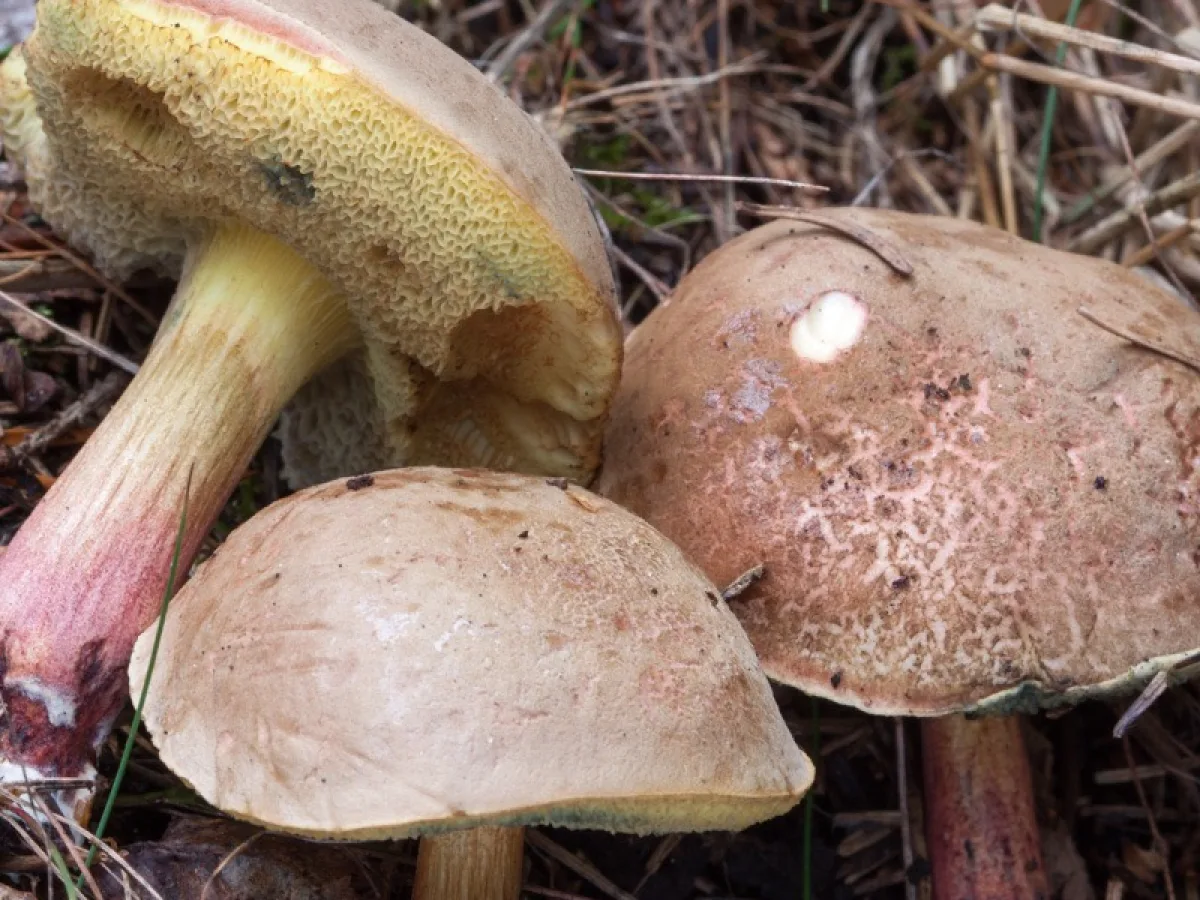
– Cap convex to expanded, velvety, brown to olive-brown.
– Cap cuticle often cracking with age.
– Tubes yellow at first, then yellow-green, with angular pores that bruise faintly blue when handled.
– Stem red, often yellow at the apex.
– Flesh yellowish-white, often faintly bluing when cut, red just beneath the cap cuticle, which becomes clearly visible when the cap surface cracks and exposes the flesh.
Xerocomoid boletes
Red Cracking Bolete
Xerocomellus chrysenteron
LC
Least concern
Edible
3 images
Characteristics
Ecology
Grows with beech and oak in southern and central parts of the Nordic region.
Notes
Edible, but not among the tastiest boletes. Works well mixed with more flavorful edible mushrooms.
Similar species
Xerocomellus porosporus is similar but has duller colors and is rarely red in the cracks of the cap, edible.
Hortiboletus rubellus has a red cap, is rare, not poisonous.
There are several other similar species in the “velvet boletes” group, but none are considered poisonous. This description includes the similar Xerocomellus cisalpinus depicted in the photo.
Hortiboletus rubellus has a red cap, is rare, not poisonous.
There are several other similar species in the “velvet boletes” group, but none are considered poisonous. This description includes the similar Xerocomellus cisalpinus depicted in the photo.

